








- -16.04%


| Delivery methods | Name | Time of delivery | Price |
|---|---|---|---|

|
Indywidualna wycena dostawy - Spedycja | Please confirm your order - delivery costs will be emailed to you as a separate proforma invoice. Shipping quote for large-volume products. Please be patient for a while. | individual valuation |
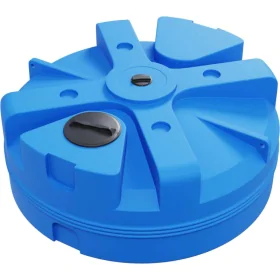
Verticon Fortress drinking water tank
Capacity 3000 l - 8000 l For drinking water, rainwater and fertilisers Robust construction with rings and stiffening ribs
Price:
Download PDF

Product compliance details: Manufacturer responsible for the product
Responsibility for the Product

Manufacturer Uhplast Sp. z o.o. Ołowiana 11 85-461 Bydgoszcz Poland sales@uhplast.pl

Model | V-3000F | V-5000F | V-8000F |
|---|---|---|---|
Nominal volume [l] | 3000 | 5000 | 8000 l |
Height [cm] | 93 | 143 | 219 cm |
Diameter [cm] | 230 | ||
Filling diameter [cm] | 14 i 35 | ||
Wall thickness [mm] | 7 | ||
Specific References

1. select a DECORATIVE TANK, which matches the colour scheme of your surroundings and has a capacity suitable for you.
2. measure the diameter of the downpipe and select a suitable RAINWATER COLLECTOR .
3. match the diameter of theconnecting hose between the collector and the tank (most collectors have an outlet of 32 mm)
4. match the TANK with the colour of the rainwater tank.
If you wish, you can equip the set with a DRAIN HOSE to empty the tank during winter.

Drinking water tanks are manufactured using rotomoulding technology, which allows the tanks to be produced as a whole, without the need to weld individual components together, which has a beneficial effect on the mechanical strength of the tank. Polyethylene tanks are lighter than their steel or resin counterparts. Tanks made of non-toxic polyethylene are ideal for storing foodstuffs as well as technical substances used in various production processes. The polyethylene material prevents the growth of algae by being impermeable to sunlight. The tank can withstand temperatures from -20 to +80 °C.
The proposed tanks are ideal for:
-storing drinking water or other food-grade liquids both indoors and outdoors,
-the construction of buffer tanks to be used in the event of pressure drops or water shortages,
-to store water for fire-fighting purposes, laundry or dishwashing,
-supplying water in the event of a shortage of water on distribution vehicles,
-collecting and using rainwater, which can be used for irrigation or toilet flushing, etc.
The polyethylene tanks have a polypropylene lid equipped with a vent with anti-fungal protection and threaded connections. Additional inlet and outlet openings can be provided on request. Here is how to properly assemble the spigots.
The hole for the spigot should be drilled with a hole saw in the centre of a flat surface located at the bottom of the tank, approximately 10 cm above the bottom of the tank. The diameter of the hole should be equal to the diameter of the spigot.
Place a gasket on the spigot and then, from the centre of the tank, pass it through the pre-drilled hole. If there are any problems with translation, the spigot can be lightly hammered in with a rubber mallet. Place a second gasket and nut on the spigot protruding from the tank.

Tighten the nut all the way, e.g. with a pipe chain spanner. Then clean the tank and the spigot of any shavings that may have occurred during assembly.

All tanks have the necessary approvals and certificates to allow the tanks to come into contact with foodstuffs.
This short guide will help you choose the right capacity for your underground rainwater storage tank - without difficult formulas. We will show you how to estimate your needs, count the amount of water from your roof, select the capacity and plan a simple garden installation.
List the uses: watering the garden, flushing toilets, laundry, washing the car, housework. This will allow you to estimate the real need for water in a typical week.
In simple terms, assume: annual rainfall × roof area × runoff coefficient. For most roofs, you can assume a coefficient of around 0.9 (depending on the roofing and the layout of the gutters).
Roof 120 m², annual rainfall ~600mm (approx. 600 l/m²). Estimate: 120 × 600 × 0.8 ≈ 57,600 l/year. This figure helps to select the capacity for a period without rain. And a period without rain can last for 3 weeks. Therefore, you must divide the result by 21 days. That is: (57600 l /365 days)*21 days = 3314 l, the result according to the estimation should be taken as a minimum. Therefore then we choose 4000l , 5000l, 6000l tanks - because of how we will use the rainwater.
It is most practical to select a tank that will store a supply of water for 2-3 weeks of your needs.
How to calculate capacity: annual rainfall × roof area × runoff coefficient ≈ annual amount of rainwater to be collected.
If you prefer, open the calculator in a new tab: Tank selection calculator. If you have any problems, please contact our customer service.
In detached houses, underground rainwater tanks are the best choice - they do not take up space in the garden, provide stable temperatures, no water freezing and allow larger capacities without affecting aesthetics.
The best material is PE, HDPE, MDPE plastic - it is lightweight, corrosion resistant, easier to install and above all airtight for many years .
It is worth paying attention to water and ground conditions. If the ground water level is high or the soil is clayey, flat tanks such as the F line, Bolt, Eco line Slim, etc., are the best choice.
On the other hand, if the conditions are normal, any solution can be used. If you have any problems, please contact our customer service.
The simplest arrangement: gully filter in front of the tank or basket filter, underground tank, floating intake, automatic pump and point of use (tap). This makes watering convenient and economical.

For example: family of 3-4 people + garden of 80-150 m² → 4000-6000 l usually works well. Larger garden / intensive watering → 8000-10 000 l. Verify with the calculator above.
Yes - using a suitable system (rainwater control unit/automatic switchover) and filtration.
Plan an overflow to an infiltration or rainwater drain in accordance with local regulations.
Top jakość! Polecam
Naprawdę dobry zbiornik – mocny, szczelny i pojemny. Woda jest w nim bezpieczna, nic się nie psuje ani nie przecieka. Fajna opcja, jeśli potrzebujesz czegoś solidnego na dłużej.
Zbiornik na wodę pitną
Bardzo dobrze przemyślana konstrukcja – zbiornik jest szczelny, wytrzymały i łatwy w obsłudze. Woda pozostaje czysta, a całość wygląda na naprawdę solidną. Idealny do domu i na działkę. Polecam!
| Nazwa | Capacity | Image | Unit price |
|---|---|---|---|
Verticon Fortress drinking water tank |
3000l |

|
|
Verticon Fortress drinking water tank |
3000l |

|
|
Verticon Fortress drinking water tank |
3000l |

|
|
Verticon Fortress drinking water tank |
5000l |

|
|
Verticon Fortress drinking water tank |
5000l |

|
|
Verticon Fortress drinking water tank |
5000l |

|
|
Verticon Fortress drinking water tank |
8000l |

|
|
Verticon Fortress drinking water tank |
8000l |

|
|
Verticon Fortress drinking water tank |
8000l |

|



Świetna jakość
Po kilku miesiącach użytkowania nadal jestem zachwycony jakością tego zbiornika. Kolor nie zmienia się, a jego funkcjonalność jest niezawodna